Power Lines
Assess the impact to health and property value
8 min read
The tall steel towers and the sizzling noise are hard to miss if they are close to a home you are touring, immediately triggering a second thought: should I be concerned about it, what are the impacts to my health, and the property value? This article offers the practical aspects homebuyers need to consider, where to look, and more importantly, how to become aware before you even tour a home.
Key Takeaways
- Health concerns about powerlines are specific to high-voltage transmission lines, and more specifically the electromagnetic fields (EMF) they emit.
- A magnetic field's strength "decreases rapidly with increasing distance from its source," so distance is the variable that matters the most.
- The scientific research on EMF's impact to health is inconclusive.
- The factors that more clearly affect a purchase are practical, not medical: a utility easement on the lot, the view, faint "corona" noise, and how the next buyer will perceive it.
Above all, distance is the factor that matters most for a high-voltage powerline near a home you like: not only for health, but for the other practical concerns too, which fade rapidly as distance grows.
Transmission lines vs. the wires on your street
Not all power lines are the same, and the distinction matters.
High-voltage transmission lines are the heavy-duty corridors, the ones the U.S. Energy Information Administration describes as "hanging between tall metal towers" that "carry electricity over long distances." The wires on your street, by contrast, are distribution lines: the lower-voltage poles and wires that deliver power to homes.
Both produce EMF, meaning electromagnetic fields. One useful detail: the electric field is "effectively shielded by materials such as trees and walls," so essentially all the attention goes to the magnetic field. That field, per the National Cancer Institute, "decreases rapidly with increasing distance from its source." In plain terms, it is strongest directly under the conductors and fades fast as you move away.
Distance is the whole game.
Do power lines harm your health?
The short answer: there is NO established evidence, and the health science research is inconclusive. After decades of study, the National Cancer Institute reports "no consistent evidence for an association between any source of non-ionizing EMF and cancer." No biological mechanism has been found, and studies of adults show "no evidence of a link" to cancer.
However, some studies of children near power lines found a "weak" statistical association with childhood leukemia. On the strength of that single unresolved signal, a World Health Organization panel rates these fields "possibly carcinogenic to humans." This means a link cannot be ruled out, not that harm has been shown.
California's utility regulator reached the same conclusion and acted on it. The CPUC says it is "unable to determine whether there is a significant scientifically verifiable relationship between EMF exposure and negative health consequences," and for that reason it set no numeric exposure limit.
So what actually matters?
Besides the potential health issue, the concrete impact of living near power lines is more practical and it comes down to four things:
- The easement, or right-of-way. Transmission lines sit in a recorded utility easement, and if it crosses or borders the home you like, it can limit what you build, plant, or store near the lines and grants the utility access to your land. The details are usually provided in the easement and the preliminary title report.
- The view. Steel-lattice towers and heavy conductor spans are a visual presence, rarely appealing, and can weigh on the property values around them.
- Audible noise. High-voltage lines can produce a faint hum or crackle, called "corona," most noticeable up close and in damp weather. Worth listening for on a site visit.
- Resale perception. If it is a concern to you, it is a concern to others too. Even if you find the science reassuring, some share of future buyers will not, so proximity can dent marketability and price regardless of the measured risk. When you sell, you inherit the next buyer's worry.
Although not as concerning as high-voltage transmission lines, the ordinary distribution lines on your street are worth a quick look too, since they cause most weather- and wildfire-related outages. California has spent decades moving them underground: the CPUC says converted infrastructure "is also more reliable than overhead infrastructure" and helps "make wildfire prone areas safer," and that "since the 1960s, most new distribution facilities have been designed and installed underground." So newer neighborhoods tend to have buried distribution lines, which means less overhead clutter and more resilience when the weather turns.
How to check a specific address
The good news: this is one of the easiest risk factors to check yourself, because the lines are visible. You don't need a meter or an expert, just three steps:
- Look at the lines. They show up on satellite and aerial imagery, and they are unmissable on a site visit. Gauge the distance from the house to the nearest big high-voltage corridor; that is the number that matters.
- Pull the title. The preliminary title report and recorded easements reveal whether a utility right-of-way crosses the parcel and what it restricts.
- Don't look for an official cutoff, there isn't one. Because the CPUC deliberately set no numeric limit, there is no government "too close" line to fail. Proximity is an input for your own judgment, not a pass-or-fail test.
How to handle it
Being near a corridor is rarely a reason to walk away. It is a reason to run a few checks and price what you find. If a home you like sits near one:
- Visit and stand on the lot. How close are the towers, are they in your sight lines, is there audible corona in damp weather?
- Read the easement in title. Get a real-estate professional's read on whether the right-of-way touches the parcel.
- Weigh resale deliberately. Assume some future buyers will discount it, and price that in when you negotiate.
- If EMF still worries you, prefer distance. NIEHS's posture is "prudent avoidance," not alarm, and since the field drops off rapidly with distance, simply choosing more setback is a reasonable, low-stakes way to feel better.
How OpenHomeVue helps
Distance to the nearest high-voltage line is the one number that matters the most, and OpenHomeVue puts it on every property before you tour. On the Key Considerations card, the Powerline Proximity chip reads that distance in plain language, such as Close (350 ft), Nearby (0.76 mi), or None within 1 mile, color-coded so a close line stands out across your whole watch list.
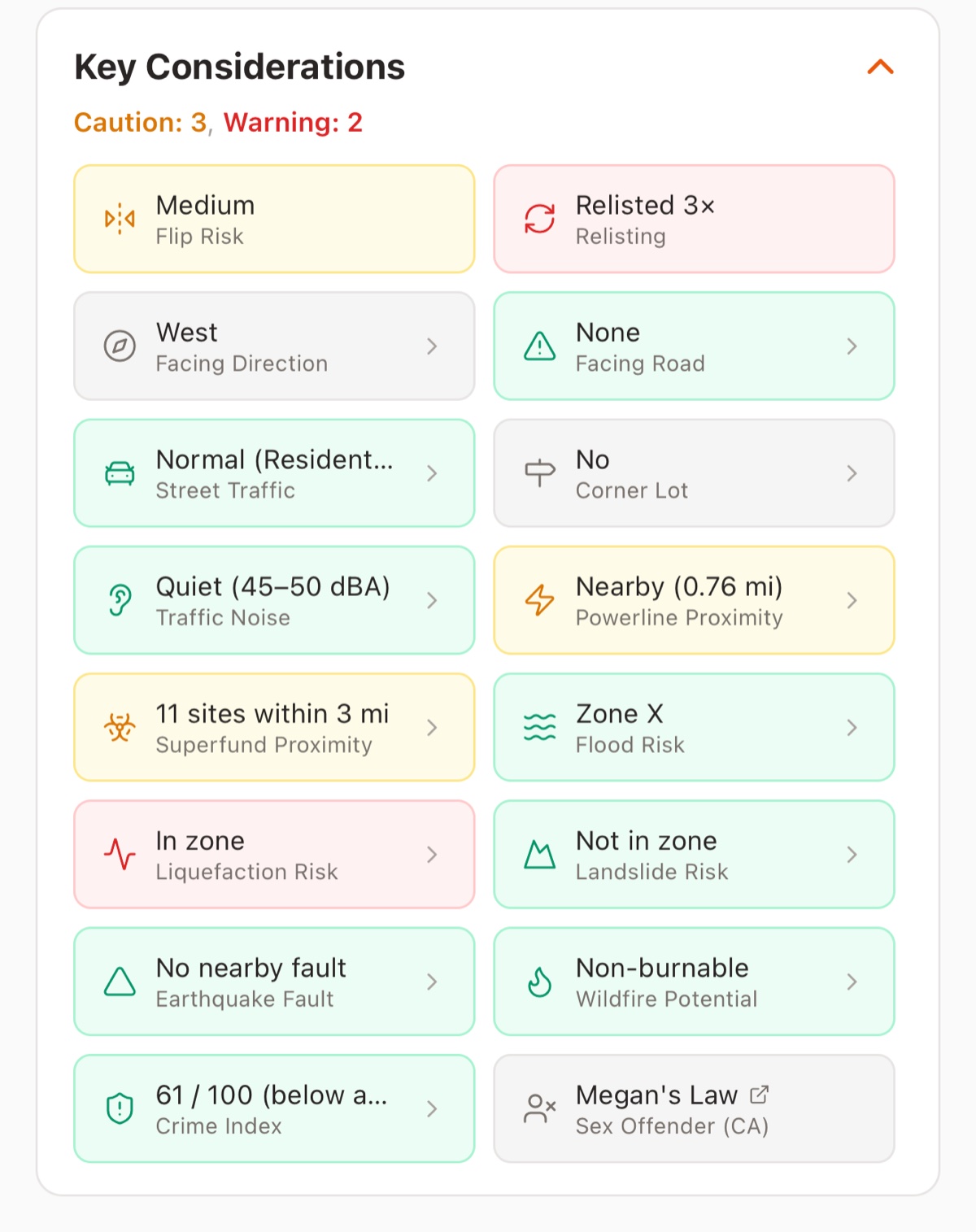
Every property gets a Key Considerations card; here the Powerline Proximity chip shows the distance to the nearest high-voltage transmission line.
There's a map overlay, too, so you can see exactly where the lines run relative to the lot, plus map measuring tools that help you gauge the exact distance to the towers and transmission lines, all before you spend a Saturday driving out there.
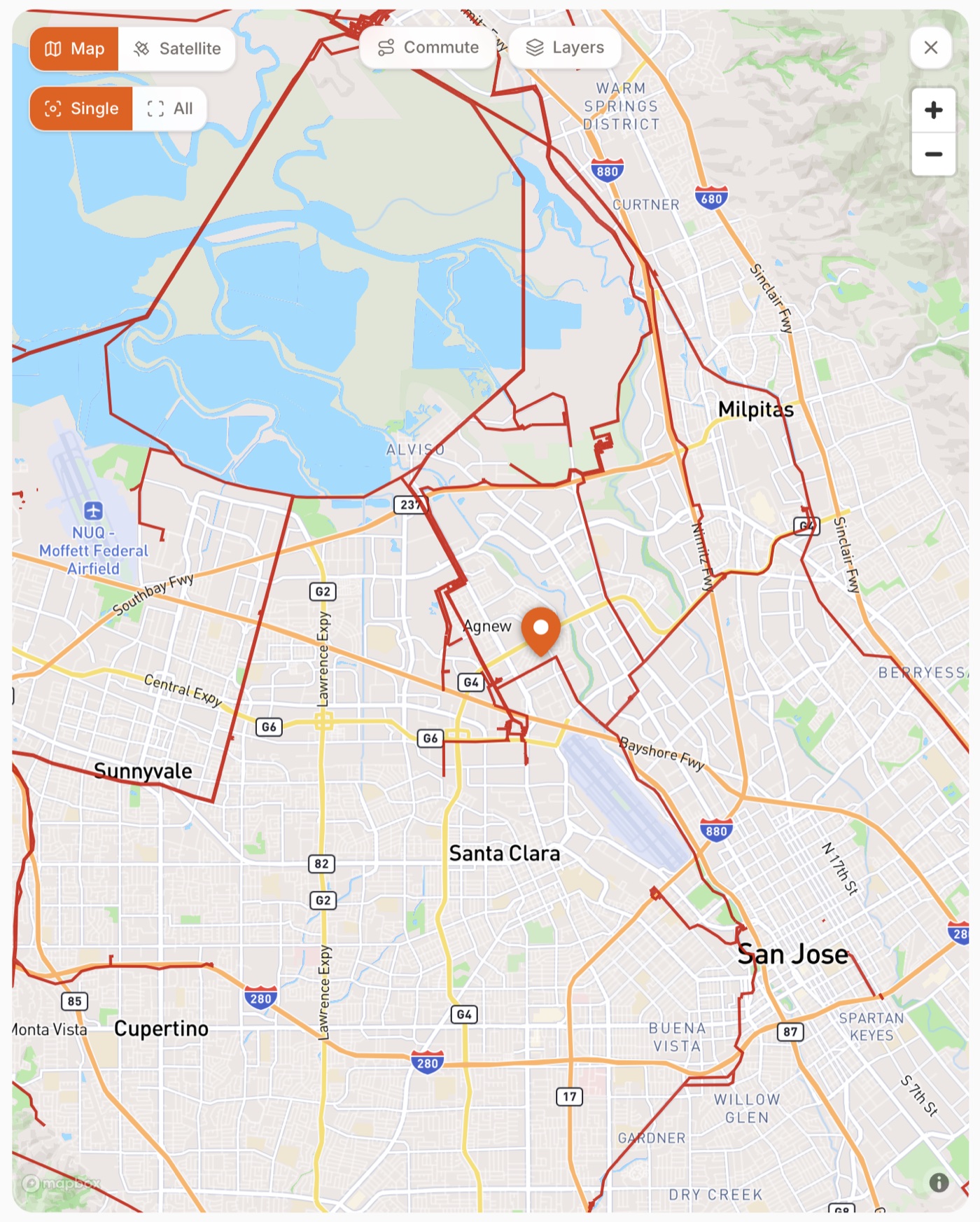
The same property's nearest transmission lines on the map overlay, so you can see whether the home sits under a corridor or a comfortable distance from it.
OpenHomeVue sources the transmission-line locations from a public, crowd-sourced dataset, not an official government source. So treat the chip as an early flag to go look in person, not a precise measurement or a health verdict. The value is timing: knowing whether the home you like is close to high-voltage powerlines, so you can make an informed decision to go ahead or take a pass.
References
- National Cancer Institute, Electromagnetic Fields and Cancer
- National Institute of Environmental Health Sciences, Electric & Magnetic Fields
- National Institute of Environmental Health Sciences, EMF: Electric and Magnetic Fields Associated with the Use of Electric Power, Questions & Answers
- U.S. Energy Information Administration, Electricity delivery to consumers (transmission vs. distribution)
- U.S. Energy Information Administration, Today in Energy: high-voltage power lines and the grid
- California Public Utilities Commission, PUC Actions Regarding EMFs
- California Public Utilities Commission, EMF Design Guidelines for Electrical Facilities
- California Public Utilities Commission, Undergrounding Programs Description (reliability and wildfire safety)
- International Agency for Research on Cancer (WHO), ELF magnetic field classification (Group 2B), as cited by the NCI and NIEHS sources above.
Primary sources are U.S. federal (NCI, NIEHS, EIA/DOE) or California state (CPUC) government agencies; the IARC classification is included because the U.S. government sources reference it directly. Transmission-line locations shown in the app come from OpenStreetMap, a public crowd-sourced dataset, not a government source.
Updated Jun, 2026