Landfills
Don't let them haunt you after closing
10 min read
Landfill is an often overlooked consideration when buying a home. A landfill site is not visible while touring the house, and the annoying smell is only noticeable under certain weather conditions, but it can become a major headache after you move in.
Landfill proximity is one of the most checkable facts about a property. Every landfill in California, open or closed, is accessible through a public state database. Yet no law requires anyone to point it out to you. This article covers what a nearby landfill actually means for daily life, health, and price, and how to check any property before you move along with a home you like.
Key Takeaways
- California tracks every solid-waste site, active or closed, in a public database: CalRecycle's Solid Waste Information System (SWIS).
- Landfill sites carry different statuses: an "Active" site is a daily operation; "Closed" means the waste stays in place under a cover; "Clean Closed" means it was removed.
- Closed is not the same as done. Landfill gas, roughly half methane, "will continue to be emitted for 50 or more years" after waste is placed, which is why regulators require closed landfills to be monitored for at least 30 years.
- The price effect has a shape. Peer-reviewed research finds big, busy landfills (500+ tons a day) depress adjacent home values by 13.7% on average and small ones average 2.7%.
- Nobody is obligated to tell you. Landfill proximity is not among the six statutory hazards on California's Natural Hazard Disclosure Statement.
Homebuyers need to do their own homework about landfill sites near a home they are interested in, and do that EARLY. Site status, scale, and proximity all matter for quality of life as well as the price of the property. Know them early to make an informed decision on whether to move along or just walk away.
What are the "landfills"?
Landfill sites range between two extremes: on one end is a large active operation taking hundreds of truckloads a day. On the other is a small disposal site that closed in 1978 and now looks like an ordinary hillside. The difference between those two is the difference between a daily-life question and a due-diligence question.
California's inventory of both lives in CalRecycle's Solid Waste Information System, which records landfills, transfer stations, composting operations, and closed disposal sites, each with an operational status. Two of those statuses are easy to confuse and worth keeping straight: Closed means the waste is still there, capped under an engineered cover; Clean Closed means the waste was dug out and removed. A "Closed" site still has DECADES of afterlife to manage. A "Clean Closed" site mostly does not.
And the closed kind is everywhere. The U.S. Geological Survey notes that estimates for closed landfills in the United States run "as high as 100,000." Most are unremarkable neighbors. The point is not alarm; it is that "I didn't see a landfill" tells you nothing about whether one is there.
Why does it matter for California Homebuyers
Even after the gates close for operations, the buried waste keeps decomposing and produces landfill gas: roughly 45–60% methane with trace compounds that carry the characteristic odor. The federal toxic-substances agency (ATSDR) puts the timeline plainly: gas "will continue to be emitted for 50 or more years after the waste is placed in the landfill." Even under a capped, closed landfill, the gas "may be more likely to move horizontally than vertically," toward whatever sits next door.
That is why closure starts a clock rather than stopping one. Federal rules require post-closure care for 30 years, and California's own rules require the same 30-year minimum. A monitored closed landfill with a modern liner is a managed, known quantity.
An active landfill is a different conversation: less about what is buried, more about what each day is like. The practical factors, documented in the research on landfill impacts, are the ones you would guess: odor, truck traffic on the access routes, equipment noise, windblown litter, dust, and the birds and rodents that scavenging attracts.
Odor is the most common complaint related to landfills. People detect hydrogen sulfide, one signature landfill-gas compound, at 0.5 to 1 part per billion, a concentration far below levels associated with measured health effects. A landfill can be a genuine, recurring nuisance without being a measured neighborhood health hazard, and for a buyer both halves are true at once: the science is calming, and the patio dinner is still ruined when the wind is wrong.
The documented physical hazard from landfill gas is specific and local: methane collecting in enclosed spaces, ATSDR's examples being "a utility room in a home, or a basement," on or immediately next to a site. That is an on-site and next-door concern, managed by gas monitoring and construction standards, not something that spans a neighborhood.
What it costs
The best available numbers come from a peer-reviewed study that asked exactly the buyer's question: do landfills always depress nearby property values? The answer has a useful shape.
- Large, busy landfills (500 or more tons a day) depress adjacent home values by 13.7% on average, with the effect fading by about 5.9% per mile.
- Small landfills average just 2.7% next door, fading about 1.3% per mile, and 20–26% of them show no measurable effect at all.
Two critical insights: first, distance does most of the work: on those gradients, the measurable discount is largely gone within the first mile or two; second, size and activity matter more than the word "landfill." A major regional operation and a quiet closed site are two very different neighbors, and the market already prices them differently.
For a buyer the discount cuts both ways. It is a warning about resale if you overpay, and it is leverage if the price does not yet reflect a nearby site that everyone can see and smell.
How to check a specific address
- Look it up before you tour. Search SWIS around the property's county and community. For anything nearby, open the site record and note three things: status (Active, Closed, Clean Closed), type, and size. A small transfer station and a regional landfill are very different findings.
- Don't wait for the disclosures. California's statutory Natural Hazard Disclosure covers six zones: flood, dam inundation, two fire designations, earthquake fault, and seismic hazard. Landfill proximity is not one of them.
- Visit deliberately. If a site is within a mile or two, tour on a warm afternoon, check which way the prevailing wind runs relative to the house, and drive the truck route. Ten extra minutes answers the question no database can: what is it actually like here?
- Walking away is also an option. If the home you like has an active landfill site nearby, or a closed one whose odor you can still smell, maybe consider other homes on the market.
How to deal with it
A landfill within a few miles is common, and most of the time it changes nothing. When one turns up near a home you like:
- Triage by status and size first. Active and large: weigh the daily-life factors and the documented price gradient. Closed and small: usually a footnote, worth one look at the site record.
- Let distance do the math. Within the first mile, take the question seriously: visit more than once, and treat the research numbers as your negotiating floor. Beyond a couple of miles, the measurable effects thin out fast.
- Price it, don't just fear it. If the nuisance is real, the discount should be too, when you buy and again when you sell. The next buyer will see the same map you did.
- Reserve the deep dive for the close calls. Environmental consultants, gas-monitoring records, and county mitigation files exist for the genuinely adjacent cases. Most buyers never need them; the ones who do, really do.
How OpenHomeVue helps
The whole problem above is an awareness problem, and awareness is exactly where OpenHomeVue helps. Every property on your shortlist gets a Key Considerations card, and its Landfill Proximity chip reads the state's own solid-waste records for you, in plain language: None within 3 miles, or 2 sites within 3 miles. The color carries the meaning at a glance: it flags red when an active site is within 3 miles or a closed one is within 1 mile, and amber when a closed site sits farther out, so the difference between "regional landfill next door" and "old closed site across town" is visible before you ever tour.
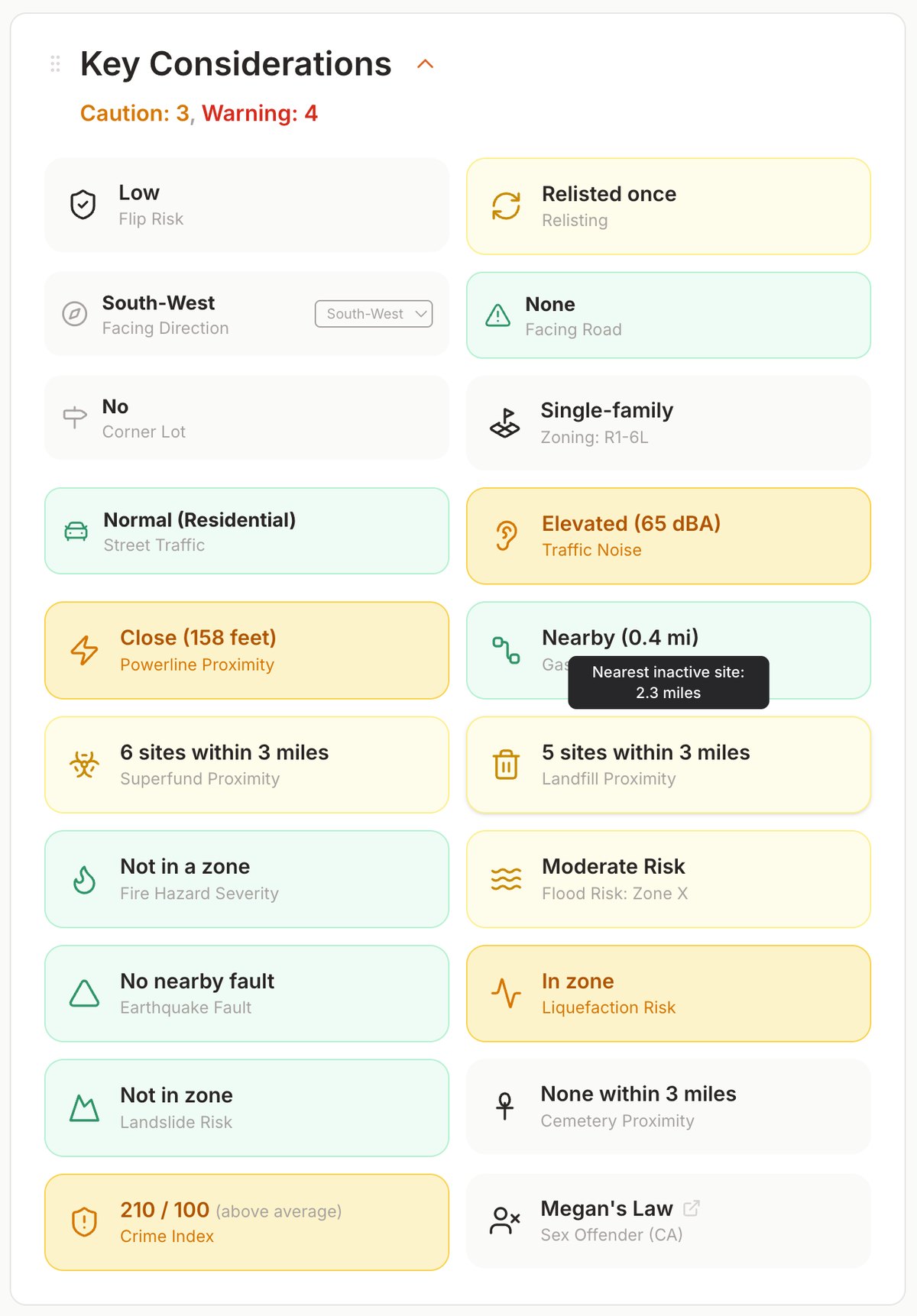
Every property gets a Key Considerations card; here the Landfill Proximity chip counts the solid-waste sites within three miles, color-coded by status and distance.
The map overlay shows each site where it actually sits, with active and closed sites drawn differently, and the measuring tools let you check the real distance from the lot to the site boundary, downwind or not, before you spend a Saturday driving out.
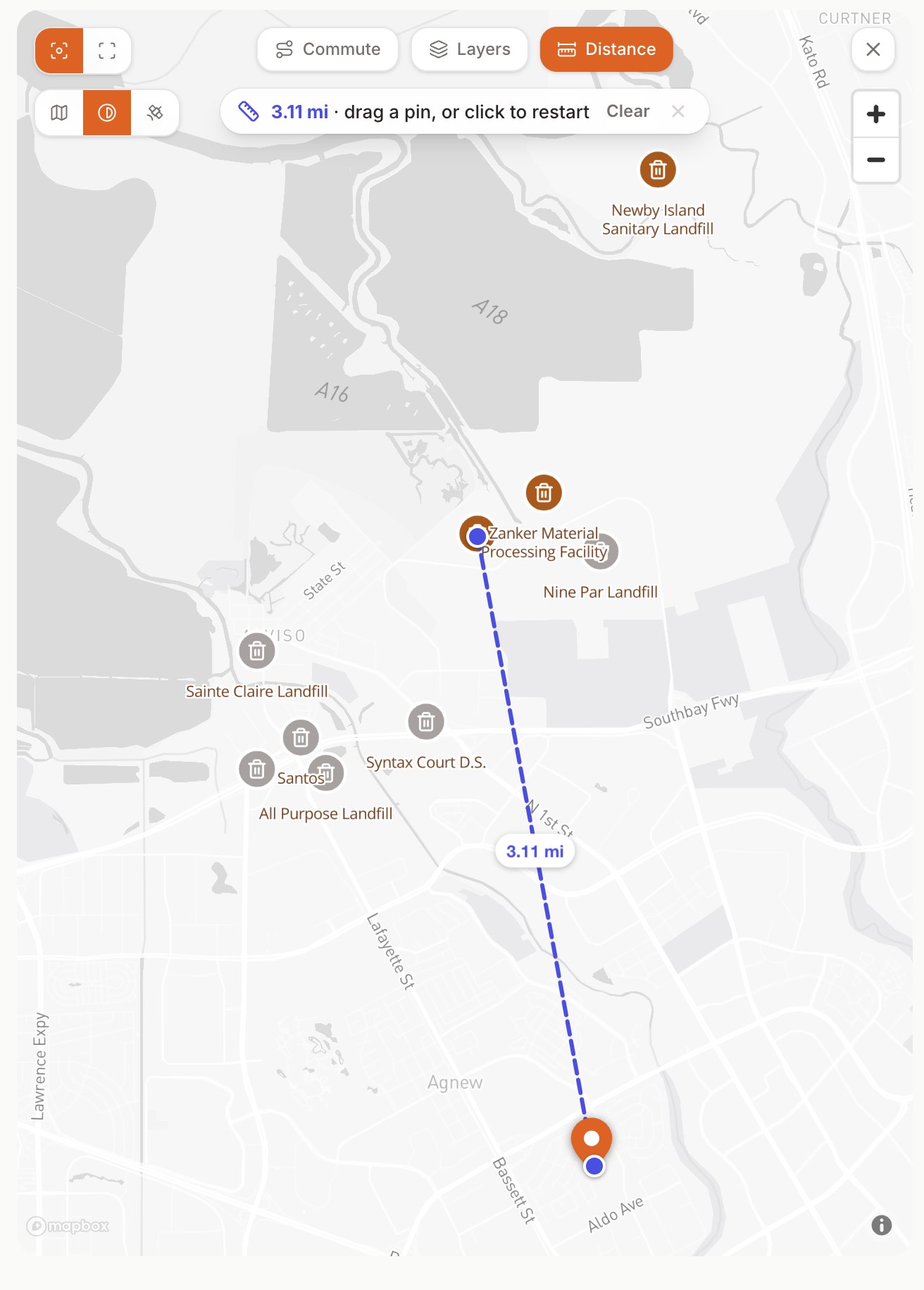
The same property's nearby landfill sites on the map overlay, active and closed sites drawn differently, so you can see exactly where each one sits relative to the home.
The data comes from California's public solid-waste site records, the same inventory behind SWIS, so treat the chip as an early flag to investigate, not a health verdict or an appraisal. The value is timing: the wind-shift discovery happens on day one, on a map, instead of a month after closing.
References
- CalRecycle, Solid Waste Information System (SWIS) Site Search
- U.S. EPA Landfill Methane Outreach Program, Basic Information about Landfill Gas
- ATSDR, Landfill Gas Primer, Chapter 2: Landfill Gas Basics
- ATSDR, Landfill Gas Primer, Chapter 3: Landfill Gas Safety and Health Issues
- U.S. EPA, Municipal Solid Waste Landfills
- 40 CFR §258.61, Post-closure care requirements
- California Code of Regulations, Title 27, §21180 Postclosure Maintenance; §21190 Postclosure Land Use
- U.S. Geological Survey, Norman Landfill Research Site, Fact Sheet FS-040-03
- Richard C. Ready, Do Landfills Always Depress Nearby Property Values? Journal of Real Estate Research 32(3), 2010
- Vinti et al., Municipal Solid Waste Management and Adverse Health Outcomes: A Systematic Review (2021)
- California Civil Code §1103.2, Natural Hazard Disclosure Statement
Primary sources are U.S. federal (EPA, ATSDR, USGS, Code of Federal Regulations) or California state government (CalRecycle, CCR Title 27, Civil Code). The property-value figures come from one peer-reviewed academic study (Ready 2010), included because no government source quantifies the effect; it is a meta-analysis of U.S. studies, not California-specific. Landfill locations shown in the app come from California's public solid-waste records.
Updated Jul, 2026