California Earthquake Fault and Liquefaction Zones
Spot them early to avoid costly regrets
Updated 2026-06-21
It's easy to fall for a dream house, and hard to recover from finding out it sits in a liquefaction zone, or worse, an earthquake fault zone. And even when that fact does surface, buried in a hundred-page disclosure packet, you're left wondering: what are my options, and what's right for me?
This article covers the essentials of California's earthquake fault and liquefaction zones, so you can make an informed call when it counts, and, better yet, spot them early, before you ever tour.
Key Takeaways
- Earthquake Fault and Liquefaction are two different earthquake hazards
- Liquefaction is more common in California, especially in the San Francisco Bay Area, while Earthquake Fault traces and zones are narrow
- Homebuyers can find risk disclosures in each property's disclosure packet; sellers are obligated by law to disclose
- Earthquake damage is not covered by standard homeowners insurance. Earthquake insurance is very expensive, with homeowner-unfriendly terms and hefty deductibles.
Being in a mapped zone is not necessarily a deal-breaker. It's a prompt to look closer, and a likely reason to negotiate.
What earthquake fault and liquefaction actually are
They get lumped together, but they're two different things.
Surface fault rupture is the ground physically tearing along a fault line during a quake. Under California's Alquist-Priolo Act (passed after the 1971 San Fernando earthquake), the state draws Earthquake Fault Zones where a home for human occupancy "cannot be placed over the fault and must be a minimum distance from the fault (generally fifty feet)."
Liquefaction is about the soil, not the fault. When "loose, water-saturated sediments lose strength and fail during strong ground shaking," the ground briefly behaves like a liquid. On the state's map, "the soil temporarily turns to quicksand and cannot support structures." Homes can shift, sink, or tilt, leaving cracked foundations, buckled walls, and uneven floors. Because it's about soil plus water plus shaking, liquefaction can occur far from any fault, which is why California maps it separately, keying on shallow groundwater (less than 40 feet deep) in young, loose sands and silts.
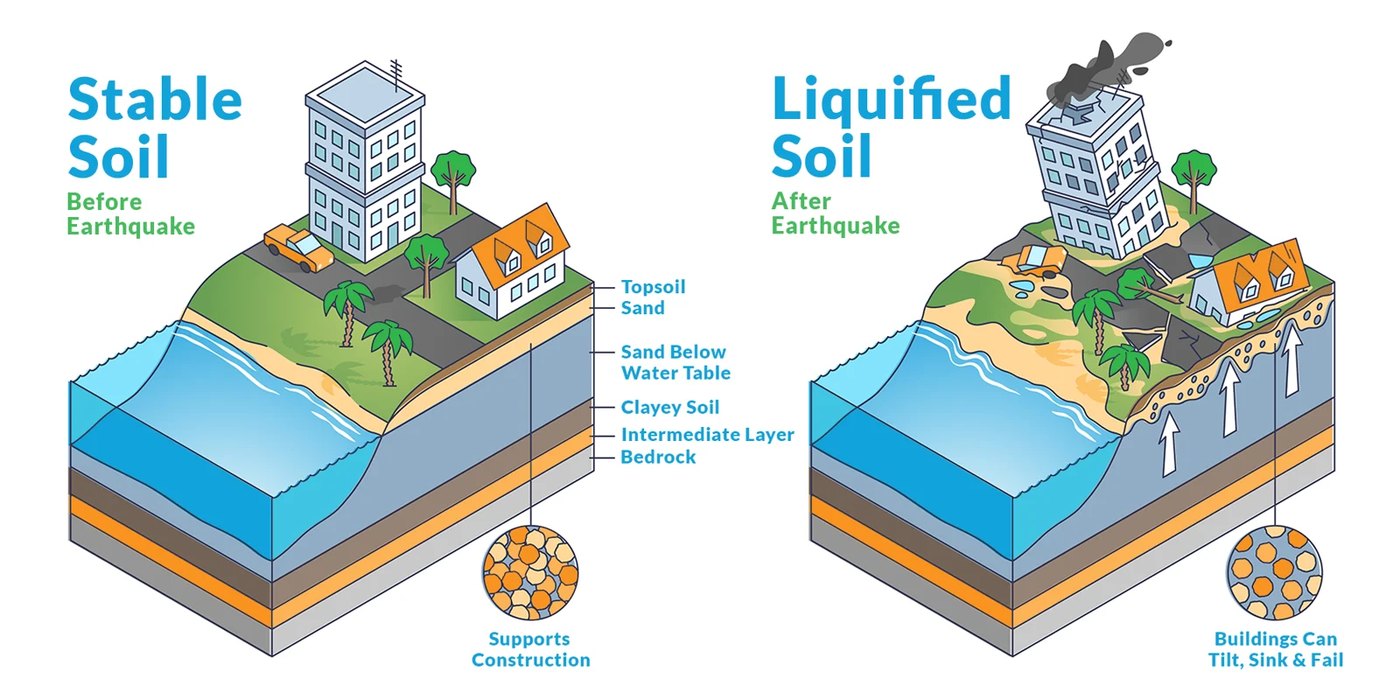
How liquefaction works: stable soil carries a building, but when an earthquake shakes loose, water-saturated sand, the grains lose contact and the ground behaves like a liquid, so buildings can tilt, sink, or fail. Source: WSRB.
Why it matters in California
After the 1989 Loma Prieta earthquake, California passed the Seismic Hazards Mapping Act of 1990, which maps liquefaction, earthquake-induced landslides, and amplified shaking statewide as "Zones of Required Investigation." If a property is in a mapped zone, the seller must tell you.
And these zones aren't rare, especially around the Bay. Fault-rupture zones are narrow, so relatively few homes sit in one. Liquefaction is the far more common encounter: the worst hazard tracks the bay-margin artificial fill under San Francisco, Oakland, and Alameda. The backdrop: the USGS estimates a 72% chance of a magnitude-6.7 or larger Bay Area earthquake within the next 30 years.
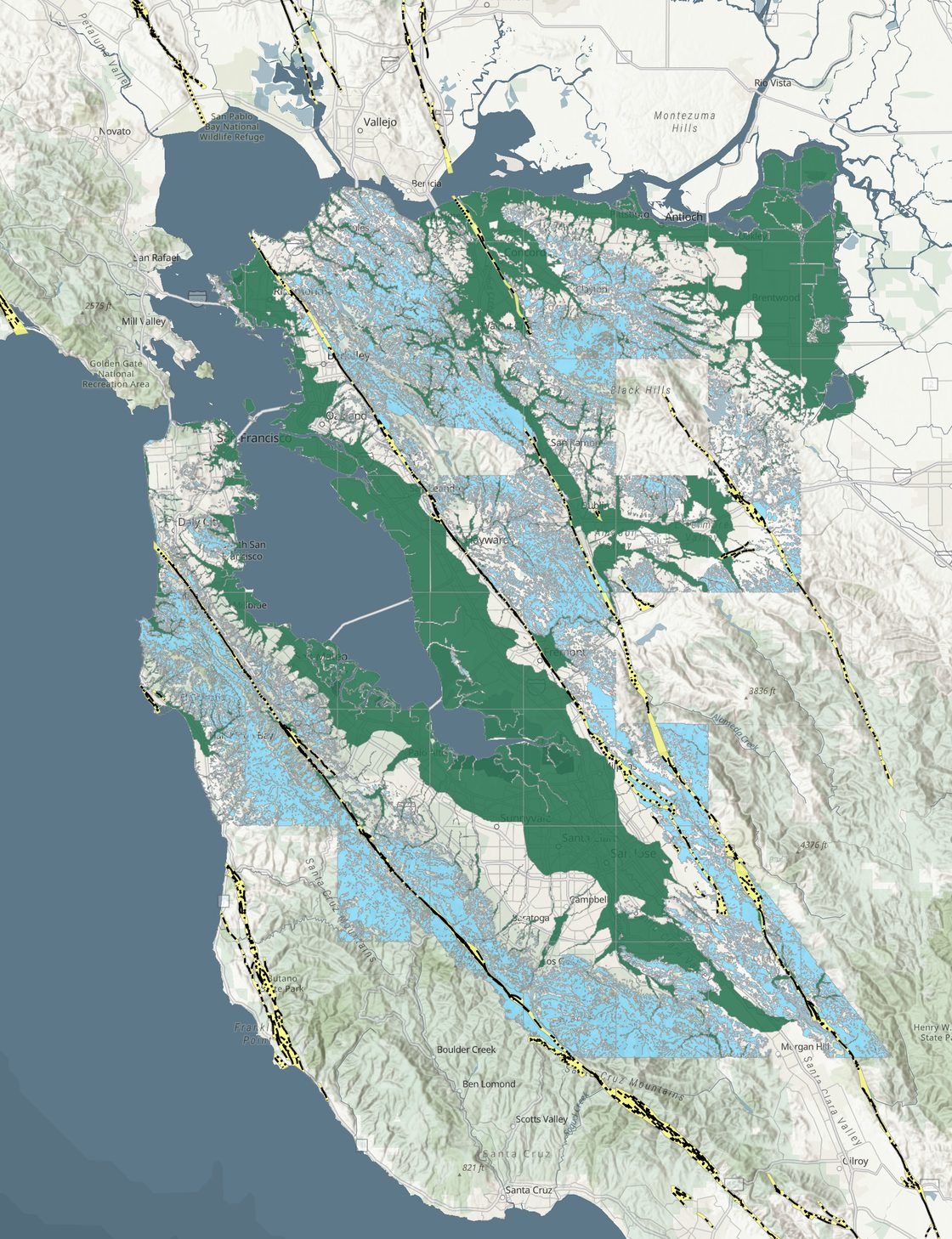
California's hazard map tells the story at a glance. Liquefaction zones (dark green) blanket the valley floor and bay margins, landslide zones (light blue) trace the hills, and Alquist-Priolo fault zones (yellow) frame the fault lines (black). That is why liquefaction is the far more common encounter. Source: California Geological Survey (EQ Zapp).
How to read it for a specific property
You don't need to be a geologist to know three things:
- EQ Zapp: the California Geological Survey's free map to "conveniently check whether a property is in an earthquake hazard zone," covering fault-rupture, liquefaction, and landslide zones. → conservation.ca.gov/cgs/geohazards/eq-zapp
- The disclosure (NHD) statement: California's Natural Hazard Disclosure has plain Yes/No checkboxes for an Earthquake Fault Zone (Public Resources Code §2622) and a Seismic Hazard Zone (§2696).
- The caveat: the maps aren't complete; CGS itself cautions the map "may not show all faults." So an unmapped address isn't proven safe, and being in a zone doesn't mean your house will be damaged. A zone is a flag for a closer look, not necessarily a deal-breaker.
What are the costs
Insurance. Earthquake damage is not covered by a standard homeowners policy. You need a separate earthquake policy. The California Earthquake Authority (CEA) covers the dwelling, personal property, and loss of use, with deductibles ranging from 5% to 25%. Premiums depend on the home's age, proximity to a fault, soil type, and foundation. The catch is the deductible: with the Bay Area's median single-family home price around $1.4 million (May 2026), a 15% deductible is roughly $210,000 out of pocket before coverage starts. That's a big reason only ~10–13% of Californians carry it.
Retrofit. Strengthening an older house is more affordable than most expect: a standard brace-and-bolt retrofit "may cost on average between $3,000 and $7,000," and the state's Earthquake Brace + Bolt program "provides up to $3,000 in grants." A completed retrofit can also earn "up to a 25% discount" on the CEA premium for older raised-foundation homes.
Liquefaction is the harder one. Bolting helps a house ride out shaking, but it doesn't fix the ground underneath it. Liquefaction mitigation means a geotechnical assessment and, potentially, ground improvement, which is more involved and more expensive than a standard retrofit.
How to deal with it
If a home you love sits in a zone, here's what to consider:
- Check early. Pull the zone status before you tour (EQ Zapp, or OpenHomeVue, below).
- Read the soils report. It's in the disclosure packet. For liquefaction, consider your own geotechnical assessment.
- Understand the mitigation options. Brace-and-bolt for shaking; geotechnical ground improvement for liquefaction; better drainage (grading, French drains) to keep soil from staying saturated.
- Evaluate insurance options and costs. Price the CEA premium and the deductible against your total budget, and remember the retrofit discount you can take advantage of.
- Negotiate. Zone status is a legitimate price lever. Even a few percent off can help fund your mitigation budget.
The bottom line: being in a zone isn't necessarily a deal-breaker. It can be a manageable risk if handled right. Knowing early is what matters.
How OpenHomeVue could help
OpenHomeVue pulls the same California Geological Survey data (Alquist-Priolo fault zones, liquefaction zones, and landslide zones) and turns it into a plain-language status on every property you're considering: clear, near a fault, in a zone, or not yet mapped, with the nearest fault's name and distance.
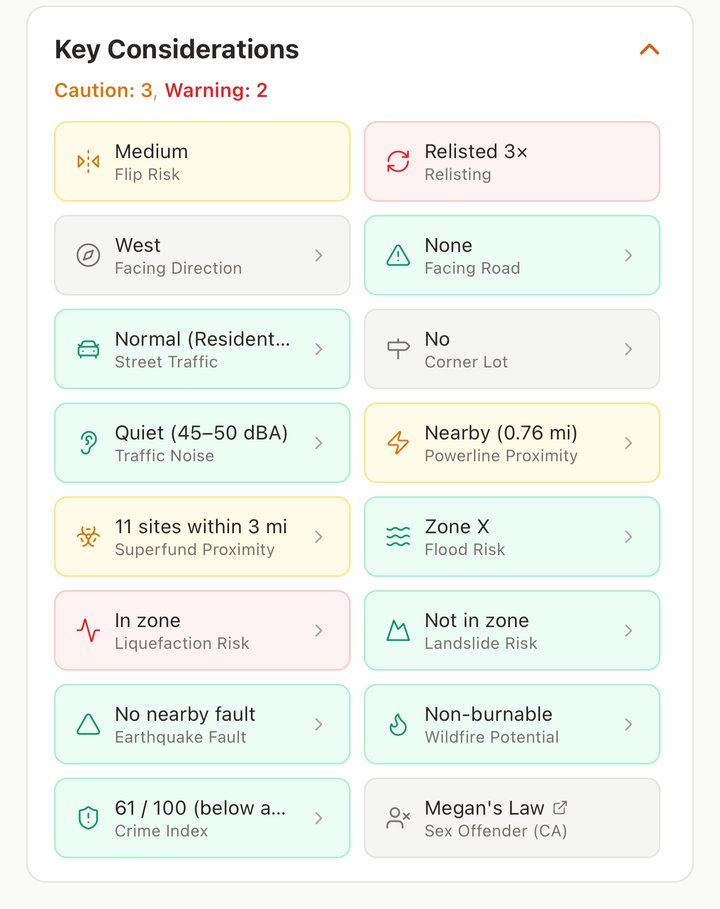
Every property gets a Key Considerations card. Here, Liquefaction Risk flags "In zone."
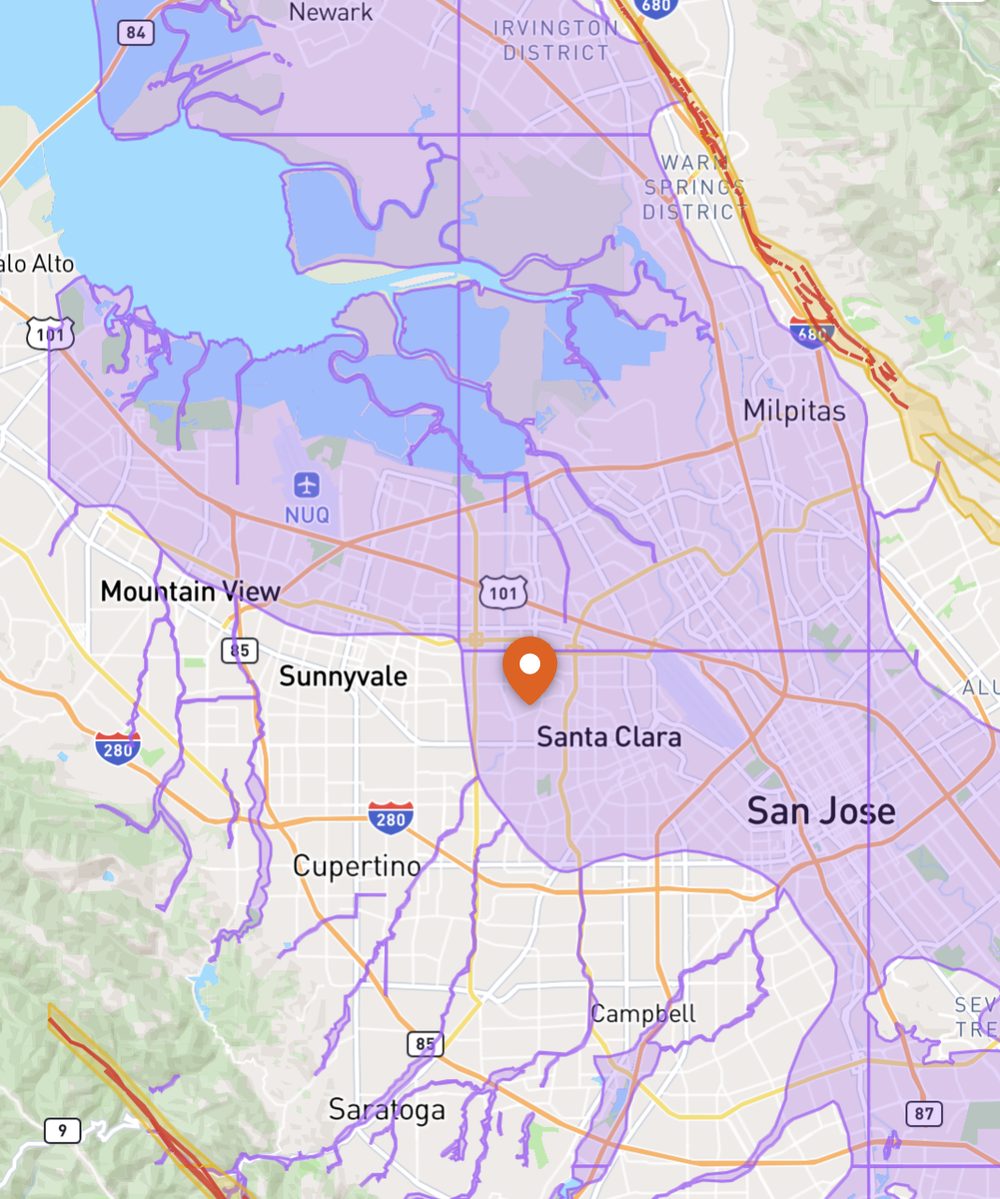
The same property's seismic hazard zones on the map overlay, tracking the bay-margin fill.
The difference from a disclosure packet is when and where you see it. Instead of page 217 of a PDF after you've fallen in love, it's right on the map, on day one, across your entire shortlist. And where the state hasn't mapped an area, we say so.
Sources
- California Geological Survey, Alquist-Priolo Earthquake Fault Zoning Act
- California Geological Survey, Seismic Hazard Zones
- California Geological Survey, Seismic Hazards Mapping Act
- California Geological Survey, EQ Zapp earthquake hazards map
- California Civil Code, §1103.2, Natural Hazard Disclosure Statement
- California Earthquake Authority, Homeowners earthquake insurance
- California Earthquake Authority, Premium discounts (seismic retrofit)
- California Residential Mitigation Program (Earthquake Brace + Bolt), Seismic retrofit cost
- U.S. Geological Survey, San Francisco Bay Area liquefaction hazard maps
- U.S. Geological Survey, Earthquake hazards program (Bay Area earthquake probability)
- NBC Bay Area, Bay Area median home price record (2026)
- NPR, Why only 13% of California homeowners have earthquake insurance
Sources 1 to 10 are official government sources; 11 and 12 are journalism, cited for the market figure and the insurance-uptake context.